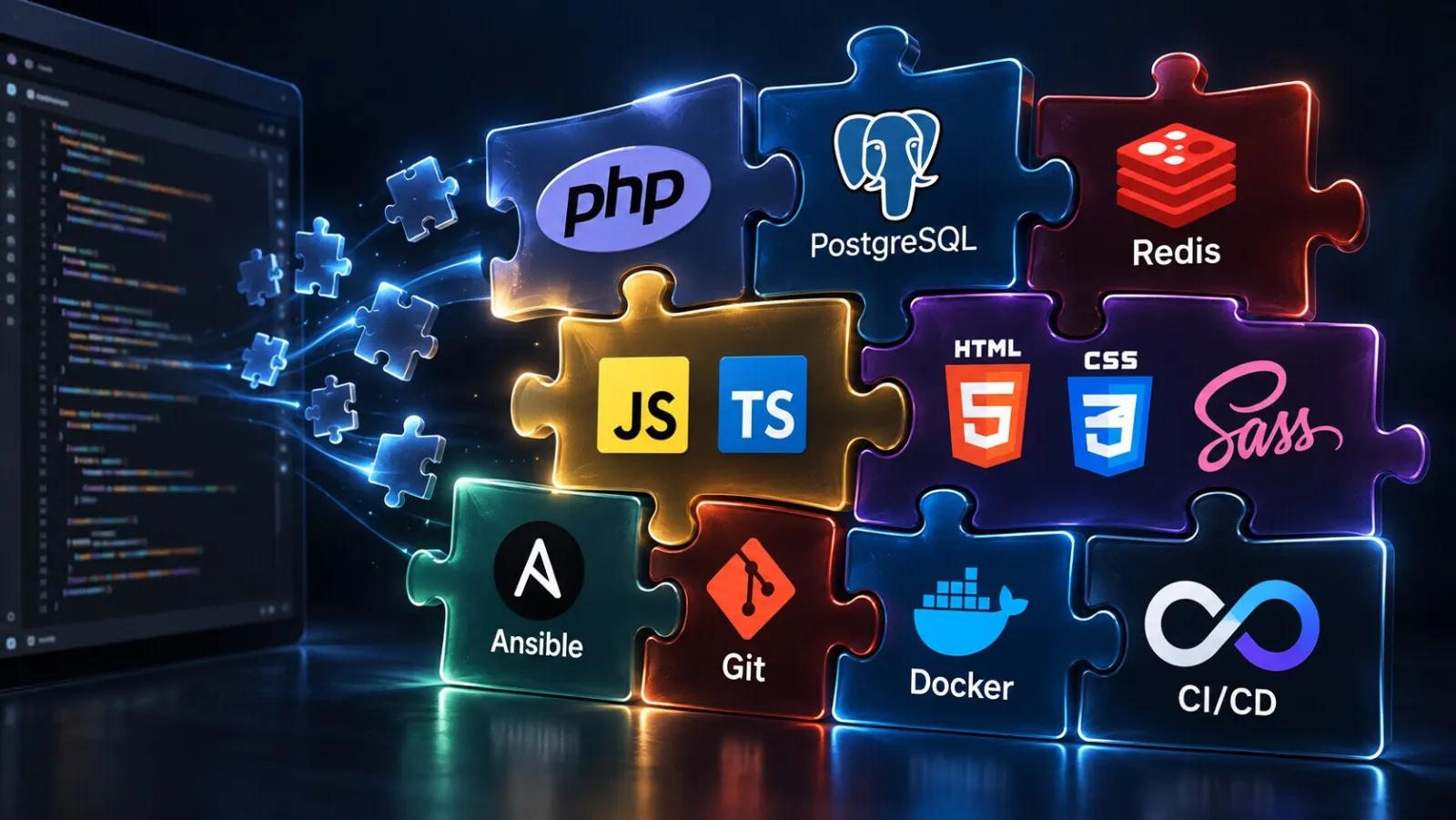
Over the years I have worked with all sorts of technologies, approaches and methodologies. Some I tried out of curiosity, some I picked up because a project called for them, and some I never got round to at all. A few clicked and stayed with me for years; others did not, or were replaced along the way.
I started putting my working stack together back in 2007. Projects changed, new tasks came along, and with them came new knowledge, experience and preferences.
In this article I want to go through what I actually work with in 2026: what goes into almost every project, and what I bring in only when a task calls for it.
One thing up front: I am not claiming these technologies are better or worse than any others. This is my personal pick — the tools I enjoy working with and solving problems with.
HTML and CSS
The technologies I first got to know back at school, taking my very first steps in building websites. Practically no interface on the web gets by without them. HTML appeared in 1990, CSS was proposed in 1994 and standardised in 1996. There is far more you can do with them now, but the basic principles have not changed.
JavaScript, TypeScript and Node.js
JavaScript was the first programming language I met after HTML and CSS, back in 2007. jQuery was everywhere at the time and one of the main tools for working with JavaScript. The language itself appeared in 1995, Node.js and TypeScript in 2009 and 2012 respectively. The JavaScript ecosystem has changed a great deal since then. These days I find it hard to picture writing JavaScript without TypeScript, and I use Node.js to build the frontend and as an extra technology for realtime and server-side rendering (SSR).
PHP
I got into PHP around 2009, and it has been my main backend language ever since. The first public version of PHP came out in 1995, and over that time «Personal Home Page» has come a long way to «Hypertext Preprocessor», picking up the best of what other languages had to offer. Today PHP is a stable language with a large community and a mature ecosystem.
Nginx
My main web server and reverse proxy. The first public version of Nginx came out in 2004. In my projects I use it to run PHP applications through PHP-FPM, serve static files, proxy requests, terminate HTTPS and balance load. I value it for its performance, flexible configuration and modest appetite for resources.
PostgreSQL
My main relational database. The first release under the PostgreSQL name came out in 1997. I used to work with MySQL, but at some point I tried PostgreSQL as an experiment — and ended up staying with it. What I like most are CHECK constraints, the rich set of data types and the extension ecosystem, thanks to which PostgreSQL is not limited to what it ships with.
Redis
An open-source in-memory data structure store used as a database, a cache, a message broker and a streaming engine. Redis appeared in 2009. It is the first thing I reach for when a project needs optimisation and scaling.
Docker
A container platform whose first version came out in 2013. These days none of my work starts without Docker — I use it locally, on test environments and in production. There is no need to install the whole set of services and project dependencies on every machine: everything runs in containers.
Git and CI/CD
I use them on every project, from day-to-day development through to deployment. Git, which appeared in 2005, handles version control, while CI/CD takes care of automating checks, builds and deploys. I stick to GitFlow, though I keep an eye on Trunk-Based Development.
Other
There are a few more technologies in my toolbox that I use less often or for more specific tasks: Bash, Ansible, RabbitMQ, Elasticsearch, ClickHouse, MongoDB, Kubernetes, Graylog and others. They come into play when a project calls for them — it depends on the requirements and the specifics of the work.
Everything above is my core stack, tested by time and by real projects. I have been using most of it for years and I keep using it today.